How do you create content as efficiently as possible?
And, more importantly…
How do you make sure it produces meaningful business results?
Over the last 12 months or so, I designed a simple content framework to help on both fronts.
I call it Straight Line Content (SLC).
If you’re a creator, a coach, or anyone who sells their knowledge online…
It should help you:
- Save time
- Keep your messaging nice and focused
- Build your authority, and
- Result in more leads and sales
Today, I want to outline how it works…
Why Content Frameworks Matter
Most people in this space don’t use a content framework.
But they’re important for one main reason:
Energy.
Evergy’s the real “currency” of content creation.
So, without a framework…
With nothing to keep that energy in place…
It usually gets scattered all over the place.
Which dilutes its potential impact.
In practice, this looks like:
- Never knowing what to post
- Posting on lots of disconnected topics
- Having huge gaps between posts
- Relying on inspiration
And, most importantly…
Rarely creating anything that connects to what you sell.
It’s what I call “Spray and Pray Content”.
In comparison…
Content frameworks act like the guardrails at a bowling alley.
Your ball can still veer from side to side.
It can bounce around a bit.
But it always heads toward the pins.
Same with your content.
In this case, the “pins” are the results you want.
Leads. Sales. Authority.
Put simply, frameworks focus your limited supply of energy.
Helping to ensure that whatever you put out heads in the right direction.
SLC is simply the framework I came up with for that purpose.
The tagline is that it, “Draws the straightest possible line to results”.
It lets you create content that delivers meaningful business outcomes.
And do so incredibly efficiently.
Here’s how it works…
Straight Line Content – Defined
At its core, SLC is:
A framework for engineering posts around a predefined business outcome.
So that your content becomes:
- Faster to create,
- Clearer in its messaging, and
- More commercially effective.
You don’t have to use it for every post.
Sometimes I’ll just post whatever comes to mind.
And that’s fine.
But SLC’s there if I need it – and when I want to make sure my content’s moving the business forward.
Here’s a schematic of the most basic version:
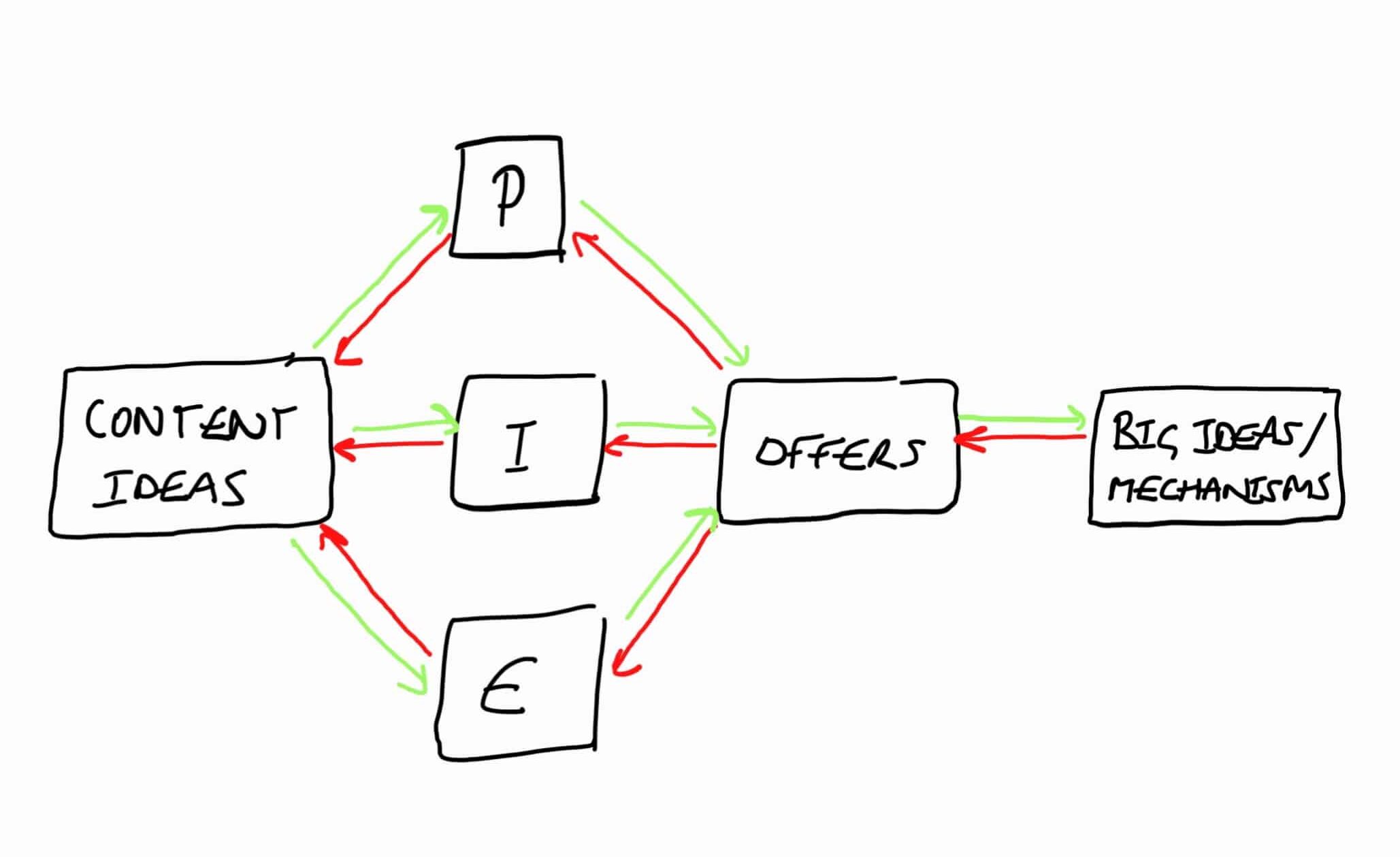
A key philosophy behind it is this:
“Every post has a purpose”.
If you look at the most successful people in this space…
Nearly everything they publish connects to what they do or sell.
They post very little at random.
Whether it’s leads, sales, or brand-building, it always has a function.
That’s what we want to do, too.
We want every post to connect to an offer or core idea in your business.
So, let’s go through what happens.
Step 1 – Decide What You’re Promoting
If you strip everything back…
The first step is deciding what to promote.
This might be a product or offer.
Or it could be a core idea in your business – AKA, a Big Idea.
As a meta example, “Straight Line Content” is one of my Big Ideas.
And, actually…
So is something I call PIE.
Once you know what you’re promoting, you use it to generate the content itself.
SHARING YOUR PIE
PIE is an acronym for 3 primary content pillars:
- Philosophy
- Issues
- Evidence
Together, they represent 3 powerful ways to build an audience who wants to buy your stuff.
Philosophy content covers what you believe.
It’s:
- Your perspective on common problems
- Your way of approaching them
- What you see that others don’t
- What you believe about life and work
Issues content addresses the problems your audience faces.
Specifically, what they are and how you solve them.
Evidence content is where you demonstrate that you’ve solved those problems in the past.
Each piece of PIE can exist as standalone pieces of content.
But the best posts often weave them together.
And that’s where SLC comes into its own.
Step 2: Forwards or Backwards?
Once you know what you’re promoting…
You have a choice:
You can either work BACKWARDS from that offer or Big Idea.
Or, if you already have an idea for a piece of content, you can work FORWARDS from it.
That’s what the different coloured arrows represent in the image.
Let’s start with working Backwards…
OPTION 1: BACKWARDS
Let’s say you’re launching a new course.
That’s what you want to promote.
From there, it’s time to “filter it through PIE”.
Starting with Issues.
Ask yourself this question:
“What issue or issues does this solve?”
Be as specific as possible.
You want to describe the symptoms.
How the problem(s) show up in someone’s life.
Because when someone describes your problems better than you can…
You trust them.
They obviously understand you.
Which makes them and their content more compelling.
So, write down your answer(s).
You often get more than one.
From there, pick whichever Issue on your list calls out to you.
Then move to Evidence.
This time, ask:
“What evidence do I have that I’ve solved this issue for someone?”
This could be…
- Client results
- Your own experience
- Or examples from others
Write them down.
Again, you’ll probably have more than one.
Then, the final question.
Philosophy.
“Why does this [course] exist in the first place?”
In other words, why does it matter?
Not necessarily to anyone else.
But to you.
Why did you make it?
Avoid anything abstract.
Get specific and personal.
Tell a story that captures why it was important to you to create this thing.
Frame it around the Issue, though.
So, if the issue you chose was something like:
“Creators spend hours making content that only gets 100 views”.
You might tell the story of when you hit “rock bottom” as a creator and how you turned it around.
That’s why the Issue matters to you.
By the time you’ve been through each question…
You’ll often have 5-10 answers in each section.
Each and every one of them is a content idea.
Moreover, each one of them ties directly to what you’re selling.
So…
That’s SLC working backwards.
Next, we’ll go through how it works when you’re starting with an idea.
But first…
I want to make an important point about SLC as a whole.
THE TRANSFORMATION
In a nutshell, I want to help people:
Turn their skills into a simple, solo, ROBUST online business that they can run in a few hours a day and make at least 6 figures from anywhere in the world.
Without needing ads, sales calls, or a big audience.
That’s what it means to be a High Agency Creator.
But, if we were working together…
We’d start by defining your Freedom Offer.
This is one primary outcome (the transformation) that you deliver for clients.
From there, we’d define the unique system and Mechanisms you use to help clients get that result.
Then we’d plan to create products/offers around them.
That’s why, in the diagram, I have “Mechanisms/Big Ideas” to the right of “Offers”.
Because…
When you work like this…
We’re not creating our content by working backward from an offer.
It starts with the Mechanism or Big Idea.
This is important.
Because this way…
Your content doesn’t just connect to what you’re selling.
It connects to the overall transformation you deliver.
This is when SLC is most effective.
Remember earlier, when I said the first step is deciding what to promote?
It absolutely CAN be.
However, the magic really happens when you identify that transformation first.
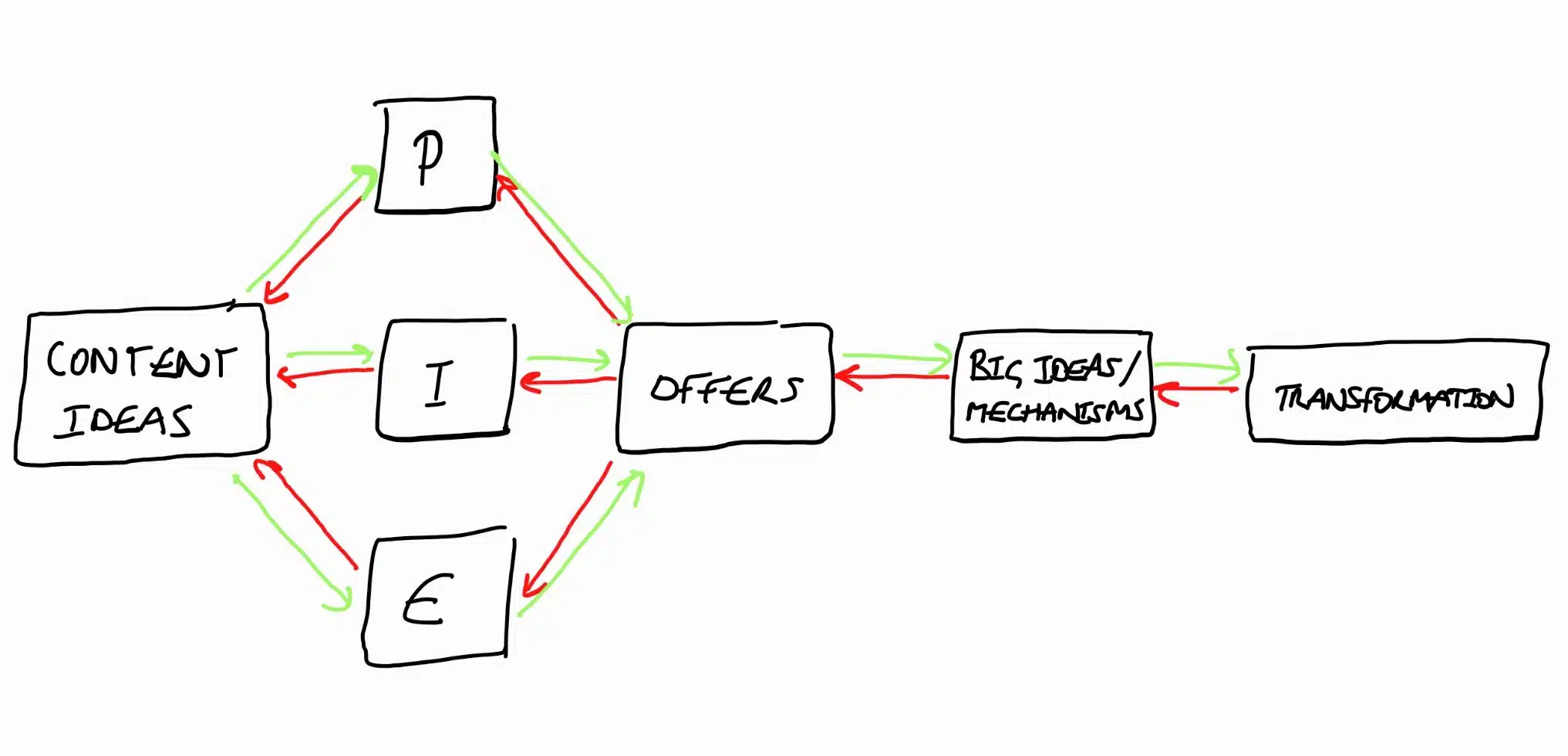
Because when you do, it functions as a sort of “North Star”.
It creates clarity.
When you work backwards from there…
And use it to define a system and mechanisms.
And then create offers that can turn leads into customers…
And THEN filter it through PIE…
Your messaging becomes incredibly clear and consistent.
So, in my case…
I help people get more agency.
It’s about freedom.
Working backwards…
My core offer helps people become a High Agency Creator.
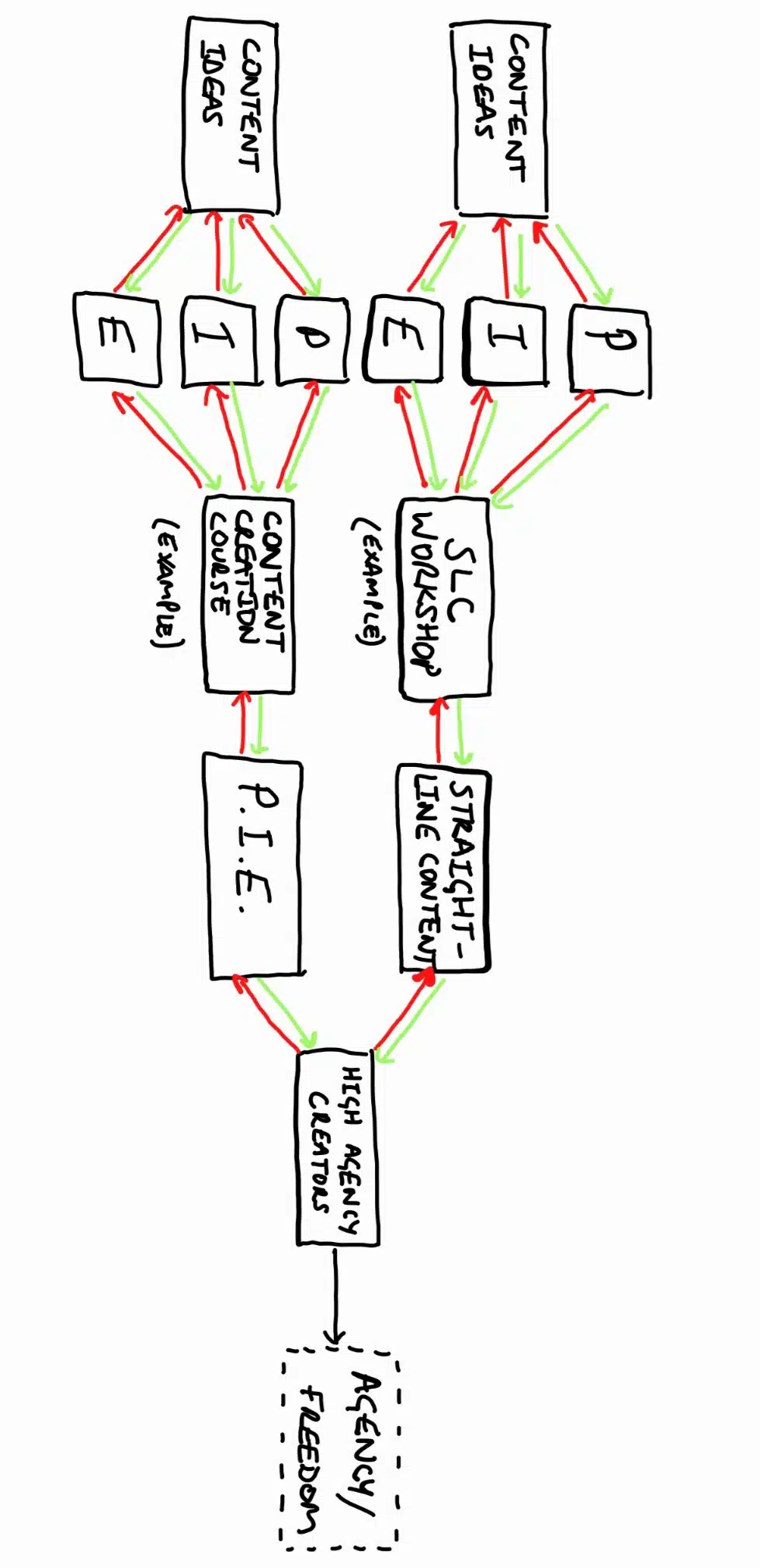
From there, I have Mechanisms and Big Ideas, like Straight Line Content, which help get the result.
Then…
I can create products that shed deeper light on them.
At THAT point, I can decide what to promote.
I might even have an Offer Calendar (vs a Content Calendar), where I map out what I’m selling and when.
That way, I always know what I’m promoting anyway.
And then I can use SLC to engineer the content.
It means every post connects to the core transformation.
There’s a through line that ties everything together.
(Remember: SLC draws the straightest possible line to results…)
Anyway!
With all that said…
Back to the article.
Here’s how to use SLC when moving FORWARDS from an idea.
OPTION 2: FORWARDS
The second way to use SLC is when you already have a content idea.
AKA, you already know what you want to talk about.
When that happens…
We start by asking a key qualifying question:
Does this idea align with the transformation I want to deliver for people?
(If you haven’t defined this yet…
Or don’t intend to work with clients…
Or whatever…
You could just ask, “Does this idea align with how I want to help people?”)
If the answer’s no…
I’d skip the idea.
Remember:
Every post should have a purpose.
If the idea doesn’t align…
Firstly, it’ll be harder to connect it to whatever you’re promoting.
But more importantly…
It’s much less likely to produce a meaningful business result.
So, you want the answer to be, “Yes, it aligns”.
From there, run it through PIE.
This time it’s a bit different, though…
Most ideas naturally fall fit into one of these categories.
So, you start by identifying the closest match.
Then use the others to add depth.
For example, let’s say your idea is an Issues post.
From there, you look for Evidence.
“What evidence do I have that I can help people solve this problem?”
Then apply your Philosophy.
“What are my beliefs or perspectives on this topic, and why?”
By answering these questions, you’re basically building the content.
It’s all stuff you can discuss in the post.
Details and stories that add colour and depth to your initial idea.
Then, finally…
You connect it to whatever you’re promoting.
There’s almost always a bridge between the two.
A quick hack I use if I can’t find it is to use ChatGPT.
I tell it my idea.
I tell it what I want to promote.
Then I ask it to find any links that make the offer or Big Idea relevant.
I’ve found it’s really effective at doing this.
From there, it’s a matter of writing the post itself.
Obviously, you can use AI for that, too!
But I prefer doing it myself.
And hopefully…
Having run it through PIE and found the connection to your offer or Big Idea…
It shouldn’t take too long.
Wrapping Up
Okay…
So that’s SLC, in a nutshell.
There’s lots of other stuff I could cover.
Things like:
- Structuring posts around a story, an insight, and offer
- Sharing Insights vs Instructions (the “what” and “why” vs the “how”), and
- Distributing the Primary Posts across platforms as efficiently as possible
These are all key features of SLC, too.
But I feel like we’ve covered a lot of ground.
And the point of this article was really just to give a broad overview of how SLC works.
So, I’ll leave those other topics for future ones.
Before you go, though, check out the 10-Minute Offer Unlock.
You can have the best content system in the world.
But your content is only ever one half of the battle.
And not even necessarily the most important one.
You need to make sure the offer you’re sending everyone to is solid.
Because if it isn’t…
Then you basically have a leaky bucket.
(Unideal when you’re trying to maximize efficiency!)
So, this is where the 10-Minute Offer Unlock comes in.
It gives you a visual depiction of the strength of your offer.
Revealing any hidden gaps and opportunities that could, basically…help you sell more stuff.
So, I recommend checking it out.
And I hope it helps if you do.
Finally…
If you want to see where SLC fits into the bigger picture of what we do as High Agency Creators…
Click here to read about the full system.