To build a business that serves our life, we need one thing:
Leverage.
In this post, I’m sharing the main systems High Agency Creators use to create it.
Specifically, in 3 key areas:
- The Offer – How you present what you do to the market
- Acquisition – How you attract clients
- Delivery – How you serve those clients
Hopefully, by the end of this post…
The idea of building a 6+ figure business that you can run from anywhere in a few hours a day will feel less elusive (or farfetched).
But mainly, I hope you get some value from the systems.
Each one can help you save time.
And run/build things with less effort.
All while having more impact.
And making more money.
So, with all that said, let’s dive into number one.
1. The Offer
So, your offer is the first and arguably most important place you can add leverage.
And there are a few things to note on how to do it.
But first it’s worth mentioning the difference between an offer and a product….
A product is the actual thing you sell.
It’s what someone gets if they buy.
Whereas an offer is the way you package and present it to the market.
In other words, a product is the gift.
And an offer is the gift wrapping.
This is important because…
If we don’t have an actual offer…
Or if our offer lacks any of the ingredients it needs to sell…
(Which I’ll get to in a second.)
Then we’ll always find it harder to sell our stuff.
Potential clients might not see the value.
They might not think it’s relevant.
They might not believe it’s achievable.
And so on.
So, this is where we start.
High Agency Creators have one core offer.
I call it a “Freedom Offer”.
Which just means we’re delivering one primary outcome or transformation for clients.
Now, I used to find this a bit confusing…
But having ONE offer doesn’t mean it’s the only offer you can make.
But the basic point is this:
We sell one core transformation because it keeps things super simple, which is key to efficiency.
From there, you want to make your offer as easy as possible to sell and buy.
Without going into too much detail, this means it contains what I call the 6 Ps:
- Promise
- Path
- Price/pricing plans
- Protection
- Perks
- Push
This paves the way for everything that comes next in terms of leverage.
Because, while a weak offer is better than no offer.
It’s like having a small lever.
You still have to put your back into it to get results.
A strong offer’s the opposite.
It makes it significantly easier to attract customers and clients.
Now, as a quick aside…
If you’re putting offers out already, check out the 10 Minute Offer Unlock.
It’s a simple tool I put together that gives you a visual depiction of the strength of your offer.
It basically lets you pressure-test it.
In the process, it reveals any hidden gaps or untapped opportunities that could help you sell your offer with greater ease.
It’s totally free and takes 10 minutes or less.
So, I recommend checking it out.
But anyway…
You have your core offer.
You’ve made sure it has the 6 Ps.
From here, you can:
Package it into a Google Doc.
Most people in this space rely on sales calls to land clients.
Which I’m not against.
They definitely work.
But they’re unideal when you’re trying to optimize for efficiency.
Why?
Because you can only talk to one person at a time.
Whereas with an offer doc, you can sell by chat instead.
That means you can message and make offers to many people at once.
But it also means you can automate the offer-making process.
(Via redirects and so on.)
So…
Just to sum this up in terms of offers and leverage.
Having one core offer keeps things really simple.
Making sure it has everything it needs to sell means you can sell it with less effort.
And then by putting it in something like a Google Doc…
You can:
- Skip sales calls, and
- Automate the process
With that in place…
The next step is to find and attract people to send the offer to.
And there are some powerful things you can do to add leverage there, as well.
2. Acquisition
In terms of acquiring customers and clients…
There are two main areas we can create more leverage:
The first is in our marketing.
Specifically around content creation.
And the second is in the sales process.
Let’s go through both.
Content Creation
From what I’ve seen…
Most people in this space lack any sort of content framework or strategy.
They don’t have anything that guides their content creation process.
The result?
They tend to create and post stuff at random.
This might look like:
- Lots of different topics
- Often totally unrelated to what they do
- Messaging all over the place
- Big gaps between posts
…and so on and so forth.
The outcome tends to be that…
Basically…
Not a lot happens.
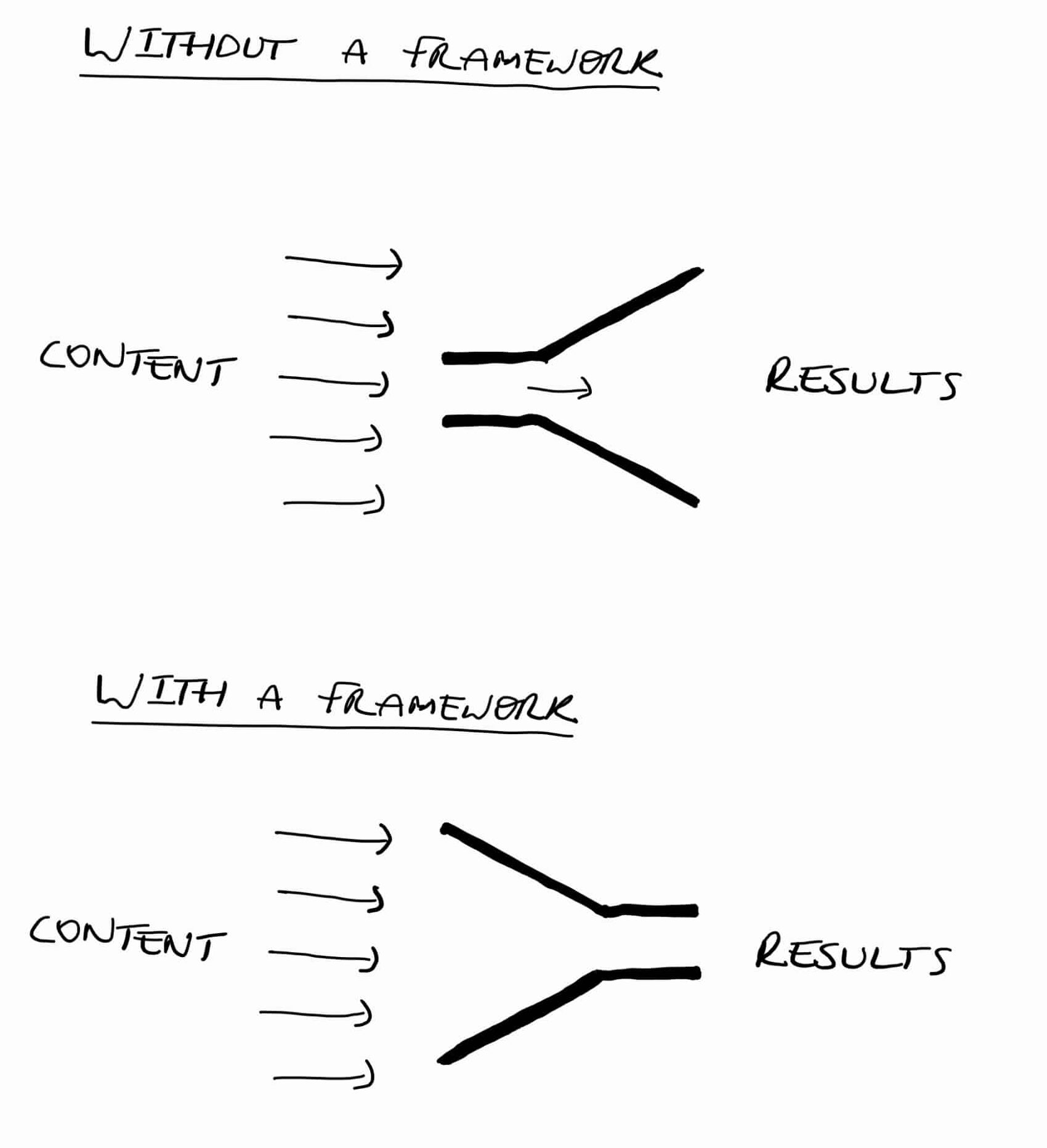
I know this because I’ve been guilty of it in the past.
Progress is excruciatingly slow.
You end up blaming the algorithm.
Watching other people get ahead.
Or just feeling invisible and as if content creation’s a massive waste of time.
So, for me…
If you don’t have the budget or expertise to run ads yet…
(Meaning one of your only other options is organic content.)
Having a framework is key.
You need something that makes the process of:
- Creating the content, and
- Getting meaningful results from it
…as efficient as possible.
That’s why I came up with something called, Straight Line Content.
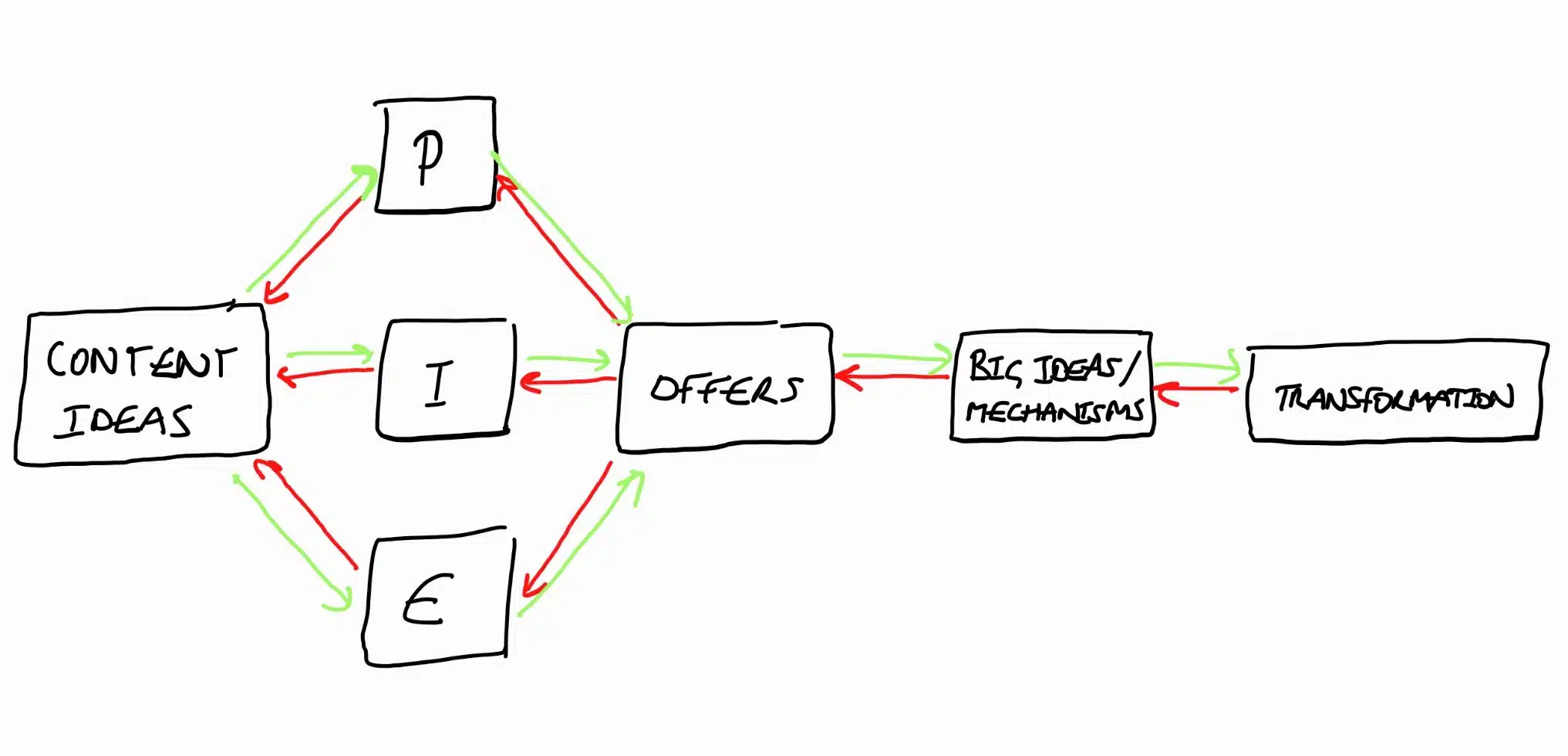
You can read all about Straight Line Content (SLC) here.
But, in a nutshell, it’s a simple framework that aims to:
“Draw the straightest possible line to results.”
You create one Primary Post a day.
(If you have no idea what to create, the SLC process provides ideas for you.)
But everything you create falls into one of 3 core content pillars:
- Philosophy
- Issues
- Evidence
And because of how you put that content together…
Everything has a clear link to your offers, Big Ideas, and, ultimately…
To whatever you do for clients.
Then, finally…
We take that Primary Post and distribute it across social.
You end up with a way to create content that:
- Is nice and quick
- Keeps your messaging tight and cohesive, and
- Builds an audience who buys your stuff.
So, this is how we make the content side more efficient.
Then, with leads coming in…
The next step is to turn them into clients.
And we can add even more leverage here.
The Sales Process
One of the most useful things I’ve learned in the last two years is also one of the most paradoxical:
The quickest route to landing a client isn’t always the shortest.
So, what does that mean?
Most creators and coaches get a lead.
Then try to sell them straight into their high-ticket programme.
A small percentage, usually about 2-3%, bite.
But the vast majority don’t.
Which is obviously super inefficient.
Like, imagine a farmer who spends the whole season growing their crops.
But then, when it came to harvest is…
They throw 98% of it away.
That’s essentially what most people in this space do.
So, we need a better way…
Here’s what High Agency Creators do instead.
Someone I learned a lot of this stuff from said we have to accept the situation for what it is:
Most people in our audience will never become a client.
So, the new goal becomes identifying who is most likely to become one.
And the best way to determine that?
Sell something cheaper to your audience first.
In other words…
Instead of trying to turn people straight into clients…
You turn them into customers first.
Any purchase signals trust.
It demonstrates intent and desire.
And it also gets someone in motion.
This is something I call Lead Momentum.
For example…
I remember buying an online course once.
After I added it to the cart, the sellers had an order bump in place.
It was a good deal, so I picked that up, too.
And then after that…
They advertised a big, “this is your only chance” discount on their most expensive course.
So I bought that as well.
That’s the basic idea behind Lead Momentum.
It’s like Newton’s Law of Motion.
Once you’re in motion, you tend to stay in motion.
And so when you sell a one-time offer to someone.
AKA, when you make them a customer.
You have a better chance of turning them into a client.
But here’s the thing:
That’s especially true if whatever they purchased is highly congruent with what you do for clients.
And that feeds into another really key point.
Because…
You can create customers simply by serving current clients.
This is where the leverage really lies on the acquisition side.
It becomes a nice little flywheel.
You take work you’re already going to do for clients.
Then you invite your audience to take part.
Then, in whatever form that work takes…
You invite those customers to become clients.
This means you generate cashflow from work you’re already going to do.
Meaning you get paid to acquire new clients.
But in the process…
You also create assets.
And remember earlier, when I said having our one core offer – our Freedom Offer – doesn’t mean it’s the only offer we make?
Well, this is basically what I was talking about…
You can package and sell those assets as new offers.
And because you created them by serving clients…
Those new offers are highly congruent with your core offer.
Which, like I said, facilitates acquisition on the client side.
When you do this…
You end up monetizing a much higher percentage of your audience.
Because, yes…
The vast majority of people in it will never become a client.
But that doesn’t mean there’s no other demand there.
People are at different stages of awareness.
And they have different perceptions of value.
In other words, people want different things.
And so, by experimenting with smaller offers…
You can tap into that demand.
You end up monetizing new segments of your audience.
This generates cashflow.
It increases your chances of landing clients.
And it creates a much more efficient audience.
Which means you don’t need such a big one to hit your financial goals.
So, at this point…
We know how to get more leverage in our offers.
As well as when generating leads, customers, and clients.
Now let’s go through how to do the same in the delivery stage.
Using something I call an Offer Ladder.
3. Delivery
Ok, so this is where most of the leverage High Agency Creators enjoy comes from.
An Offer Ladder is one offer, with different, dynamic levels of support.
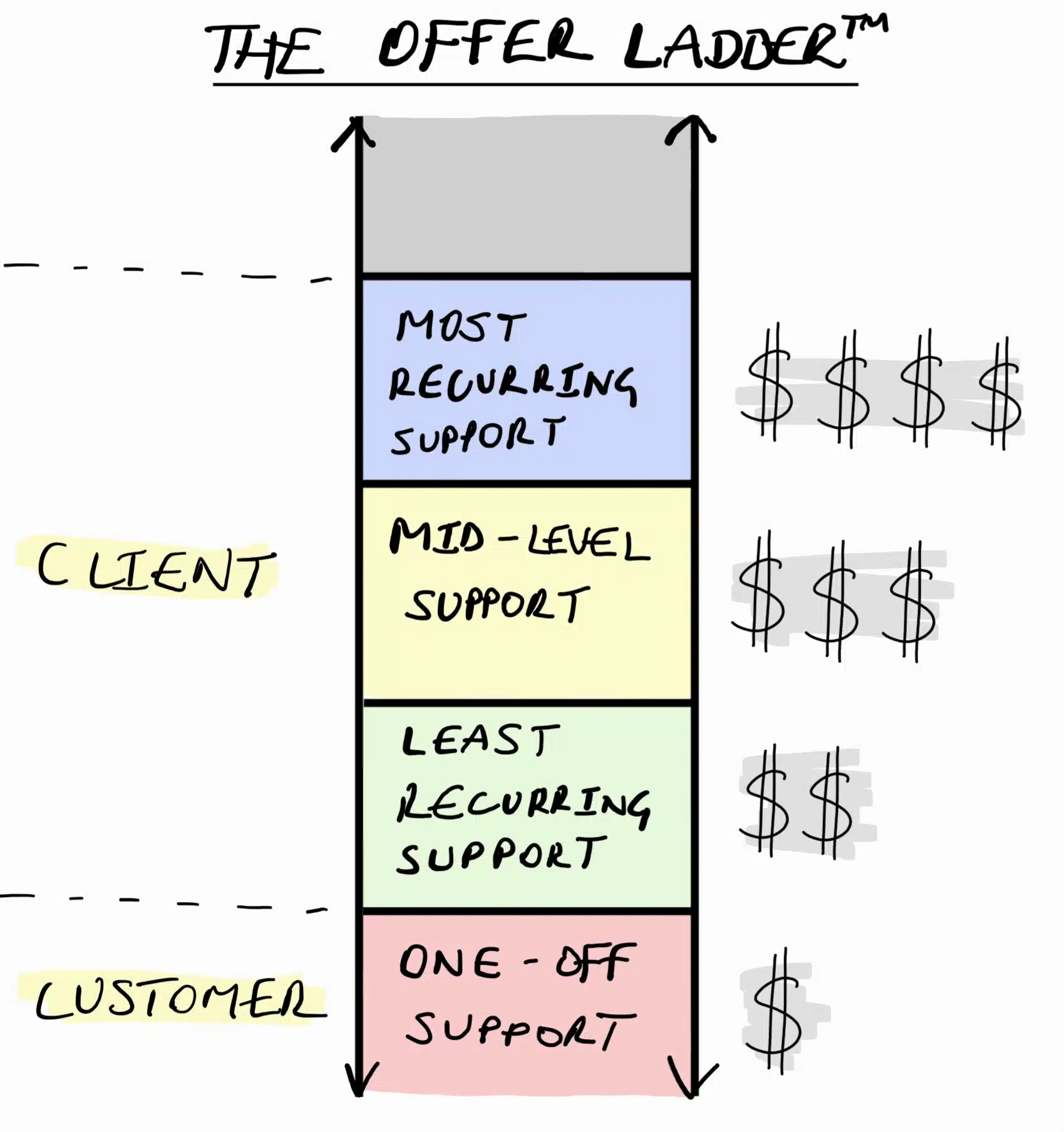
We take our Freedom Offer…
Then we sell different levels (or “Rungs”) of support.
So, everyone’s working toward the same outcome.
But at those lower Rungs, clients get less direct help from you.
And they pay less in return.
Whereas at higher Rungs, clients who want faster results can pay more and get more support.
Together, this maximizes:
- ACQUISITION – Because the cheap rungs make it easier for people to join, and
- REVENUE – Because you tap into corners of the market who will pay more for faster results.
Overall…
Offer Ladders let you have more impact and make more money…
While keeping your delivery burden low.
Most clients will stay at the cheaper rungs.
But that’s where the demands on your time and energy are minimal, too.
And far fewer clients will enter the more expensive ones.
So, even though your input is higher…
Your delivery burden doesn’t jump too much.
Another benefit:
Offer Ladders reduce churn.
Clients at higher rungs can simply “downgrade” to cheaper ones instead of leaving.
But you’re also under less pressure to get new clients.
This is a common struggle in this space.
There’s an ongoing battle between:
Using your limited time to land new clients or to serve your current ones.
This can create a vicious spiral.
Spending too long on acquisition means there’s less time to support current clients.
So, service quality drops.
Which means clients are more likely to leave.
Which then creates more pressure to land new ones.
But that changes with an Offer Ladder…
Because now your income no longer hinges on new clients.
Instead, you can focus on upselling your current ones into those higher rungs.
Which should be easier anyway.
This is something I call CLIENT Momentum.
Your current clients are people you’ve already built the most trust and rapport with.
So, by focusing on upselling them…
You can hit your financial goals without needing as many new clients.
And have more time for your current clients as a result.
Which keeps the quality of your service nice and high.
Reducing churn.
And so on.
Summing Up
So, I hope all of this makes sense.
I hope it’s been useful.
And I hope it’s at least provided some food for thought on how to run your business more efficiently.
If you’re a coach or a creator or anyone selling their skills online…
And you’d like some help with anything I’ve covered here…
Feel free to reach out.
You can email me at danny@whatsdannydoing.com.
Or drop me a DM on IG if you’d prefer.
In the meantime, don’t forget to check out the 10 Minute Offer Unlock.
And finally, if you want to learn about the full system we use as High Agency Creators, you can read all about it here.